
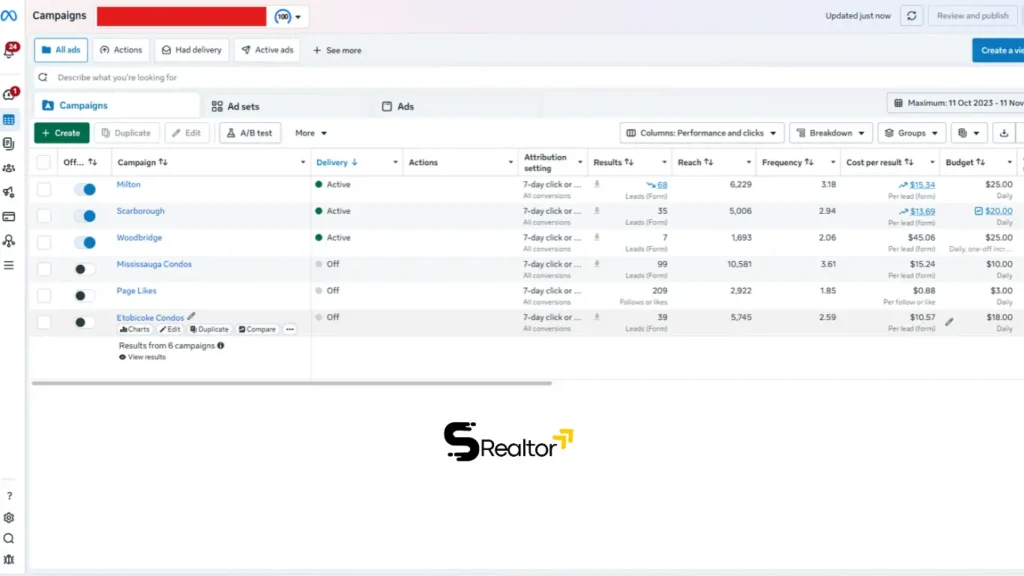
Facebook ads for real estate agents let you put a valuation offer, a new listing, or your name in front of local homeowners and buyers before they ever search for an agent. Real estate Facebook ads also come with stricter rules than most industries, because housing ads on Meta’s platforms must follow special targeting restrictions. Campaigns built without understanding those rules waste the budget or get rejected.
This guide covers where Facebook fits among your lead sources, which campaign goals make sense, what the housing rules allow, how to optimize results week by week, and what to confirm before you hire a manager. If you want a team to run it, our PPC advertising and management service handles the build and the ongoing work.
Why Facebook Still Works for Agents, and Where It Doesn’t
The audience is large. Pew Research Center’s 2025 survey found that 71% of U.S. adults use Facebook and 50% use Instagram, and Facebook is one of the few platforms used by a majority of every age group. Among agents themselves, NAR’s 2025 Technology Survey found that social media was the top lead generation tool for 39% of agents, ahead of CRM systems.
The limitation is intent. Someone searching on Google is actively looking for an agent. Someone scrolling Facebook is not, so your ad has to earn attention with a specific offer, and the leads usually need more follow-up before they are ready to talk. That is why Facebook real estate ads suit agents who have a clear offer and a process for nurturing, and why it often works best alongside search ads. Our guide to Google Ads for real estate agents covers that side.
Four Campaign Goals That Fit a Real Estate Business
Start with one goal per campaign instead of a general “get leads” push.
Goal | Typical offer | Format | What to measure |
Seller leads | Free home value report | Lead form or landing page | Cost per valuation request and per listing appointment |
Buyer leads | Local buyer guide or new listing alerts | Lead form or landing page | Cost per qualified buyer inquiry |
Listing exposure | Just listed, open house, or price update | Photo or short video ad | Local reach and inquiries on that listing |
Retargeting | Reminder or follow-up offer for site visitors | Image or video | Return visits and form submissions |
Seller campaigns tend to be the most valuable because one listing can cover months of spend, but each goal needs its own offer and its own landing page.
The Housing Rules for Meta Ads, in Plain English
Meta requires advertisers promoting housing to declare the Housing special ad category, and that declaration changes what you can do. The rules exist because of legal action. The Justice Department’s settlement with Meta over discriminatory housing ad delivery, entered in June 2022, required Meta to build a new ad delivery system for housing ads, and the court oversaw compliance through June 27, 2026.
Based on a summary by independent Meta ads educator Jon Loomer, housing ads currently face these limits, so confirm the details in Ads Manager before you launch:
- Age is fixed at 18 and up, and gender is fixed to all genders.
- ZIP code targeting is unavailable, and location targeting must cover at least a 15-mile radius around any chosen point.
- Lookalike and saved audiences are unavailable.
- Lead forms cannot collect details such as age, gender, or location.
You can still run strong campaigns. Use a radius around your market or around a listing, use your own customer lists and website visitors carefully, and let the message do the targeting. A seller offer speaks to sellers without needing a demographic filter.
Ad content has rules too. The Fair Housing Act bars housing ads that indicate a preference or limitation based on protected characteristics such as familial status, so describe the home and the offer, not who should buy it. HUD’s guidance on advertising housing through digital platforms was published in April 2024, so check HUD’s site for its current status. State advertising rules apply as well. In Texas, for example, the Real Estate Commission’s advertising FAQ requires the broker’s name to appear on ads. Have your broker review your creative. This is general information, not legal advice.
How to Optimize Facebook Ads for Real Estate: A Weekly Routine
How to optimize Facebook ads for real estate comes down to a short, repeatable review, not constant tinkering. Meta’s delivery system needs enough results to learn, so changing everything daily usually hurts more than it helps.
- Check lead quality before cost. A cheap lead that never answers is more expensive than a pricier one that books an appointment.
- Review creative performance. Pause the weakest ad, keep the strongest, and add one new variation for testing.
- Look at how often people see the same ad. When the same audience sees it repeatedly and results fall, refresh the creative.
- Check response time. If new leads wait hours for a call, no ad change will fix your results.
- Compare cost per appointment and per signed client, not just cost per click or lead.
- Adjust one thing at a time, such as the offer, the image, or the form, and write down what you changed.
When results drop, use this table to find the cause before changing anything.
Symptom | Likely cause | First fix |
Low click-through | Weak image or offer | Test a new hook and a clearer benefit |
Many clicks, few leads | Landing page or form friction | Shorten the form and check mobile load speed |
Leads, but no appointments | Slow follow-up or low-intent leads | Call faster and add a qualifying question |
Rising cost per lead | Creative fatigue or more competition | Refresh the ad and review the offer |
Leads outside your area | The 15-mile minimum radius spills over | Add a location question to the form |
Instant Forms or Landing Pages
Both work, and each has a tradeoff.
Instant forms keep people inside Facebook, load quickly on a phone, and usually produce more leads at a lower cost. The downside is lower intent, because the form is easy to submit by accident. Landing pages add a step, but visitors who complete them tend to be more serious, and you control the message and tracking.
A practical compromise is to use an instant form with a qualifying question, such as when the person plans to sell or buy, or to send traffic to a short landing page for your highest-value offers. Whichever you choose, send every lead straight into your CRM so follow-up starts automatically. Our CRM management service sets up that handoff.
Creative That Works Without Targeting Tricks
With limited targeting, the ad itself does the filtering. These formats work well in housing:
- A short video walk-through of a new listing, with the price and the neighborhood in the first few seconds.
- A local market snapshot, such as recent sales and what they mean for homeowners.
- A clear valuation offer with a single call to action.
- Testimonials and recent results, with written client permission.
Keep ads specific to your market, include your name and brokerage as required, and make the offer obvious. Our content and video editing and brand and listing design services produce the assets, so your ads look consistent with the rest of your marketing.
Speed to Lead and Consent: What Happens After the Form
Paying for a lead is the easy part. A Harvard Business Review study of 2,241 companies, The Short Life of Online Sales Leads, found that only 37 percent responded to a web inquiry within an hour, and that firms that contacted a lead within that hour were nearly seven times as likely to qualify it as firms that waited longer. The study covered businesses broadly, but the principle holds for any paid lead.
Calls and texts to those leads have rules, too. NAR’s TCPA and cold calling resource page explains how consent and Do Not Call rules apply to real estate professionals, so confirm your consent language and follow-up process with your broker. Our lead follow up service handles the first response and the follow-up sequence, and our guide to real estate lead generation services explains how the pieces connect.
What Facebook Ad Management for Real Estate Costs
Ad spend and management fees are separate. The spend goes to Meta, and the fee goes to whoever runs the account. Management is usually a flat monthly fee, a percentage of ad spend, or an hourly or project rate.
There is no reliable public price benchmark, and published figures mostly come from companies selling the service, so compare structures. Ask each provider for the minimum ad budget, what the fee includes, how often you get reports, and whether you can leave at any time. Then compare cost per appointment, not cost per click.
Facebook Ads for Real Estate Agents: DIY, Freelancer, or Managed Team
Option | Best for | Strength | Weak point |
Do it yourself | Agents with time and a small test budget | Full control and no management fee | Housing rules and learning curve can burn budget quickly |
Freelance specialist | Solo agents with a defined budget | Personal attention | One person’s availability, and real estate experience varies |
Agency or managed team | Teams and brokerages that want tracking and reporting | Creative, tracking, and follow-up handled together | Needs clear scope and account access terms |
What to Get in Writing Before You Hire
- Who owns the ad account, and will you have administrator access?
- What the fee covers, including creative and landing pages.
- How leads are delivered, tracked, and followed up.
- How the Housing special ad category and fair housing rules are handled.
- What reporting you receive and how often.
- The contract term and how to cancel.
How Scale Realtor Runs Facebook Ads for Real Estate Agents
Scale Realtor has run real estate operations since 2018. Paid ads sit inside our marketing and branding department, alongside social media, SEO, and design, so campaigns, creative, and follow-up follow one plan. You work with one account manager, and reporting is weekly once your department is live.
Engagements begin with a free discovery call, an NDA, and secure, role-based access, and most clients hand off their first function within a week, with no long contracts required to start. To see what a campaign would look like in your market, contact us to book a discovery call.
Frequently Asked Questions
You pay for ad spend, which goes to Meta, plus a management fee if you hire someone. Compare cost per appointment, not just cost per lead.
Review lead quality, creative, and response time weekly, and change one thing at a time. Judge results by cost per appointment, not clicks.
Not for housing ads. Meta fixes age and gender, removes ZIP codes, and requires at least a 15-mile radius.
They can be, but they are usually earlier-stage than search leads. Fast follow-up and a qualifying question improve quality.
Google reaches people already searching, and Facebook builds interest through offers. Many agents run both, starting with the one that fits their goal.
After a discovery call, an NDA, and secure access, most clients hand off their first function within a week.